hard.indah.link CHAPEL HILL, N.C. (Aug. 28, 2022) – The University of South Florida men's soccer team took its show on the road for the first time during the 2022 campaign to face No. 24-ranked North Carolina looking for an early season statement win. Unfortunately for the Bulls, they found themselves on the short end of a tough hard-fought 1-0 setback to the Tar Heels in the first of two-straight road contests.
The Tar Heels got on the board by way of a penalty kick in the 12' when Ahmad Al Quaq was taken down in the box. North Carolina's Milo Garvanian stepped to the spot and beat South Florida goalkeeper Jackson Weyman to the bottom right corner for the lone score of the match.
The Bulls had two opportunities within four minutes of each other when Jeffrey "JT" Copper and Jemone Barclay put South Florida's two first-half shots on goal in the 29' and 33', respectively, however, could not convert.
Weyman, who was solid all night between the posts, kept the North Carolina lead to one goal when Hilli Goldhar got to within five yards of the goal and sent his shot to the far right post only to have the Bulls' keeper get his heel on the ball sending it out of bounds in the 39'.
Barclay gave South Florida its best chance of the night at the start of the second half with a blast from 22 yards out in the 52' that was punched over the crossbar at the last second.
In the 63' North Carolina nearly took a two-goal advantage when Akeim Clarke beat Weyman from a tough angle on the far-right side, sending his offering to the far post. His shot ricochet off the post and came back across the box and was cleared by the Bulls' defense.
Weyman, who finished the match with six saves, continued to stifle the Tar Heels, especially in the final 23 minutes of the contest, giving South Florida a chance to level the match.
In the 67' Weyman faced a shot from five yards out that deflected off the bottom of his foot and off and over the crossbar. He nearly re-created that play in the 88' on a point-blank shot from three yards that was kicked out and cleared by the Bulls.
South Florida was unable to convert in the final minutes of the match.
Up Next
South Florida will close out its short two-match road stretch on Friday when it travels to Milwaukee, Wis. to take on Marquette. Kickoff is slated for 8:05 p.m. ET. The Bulls will return home to Corbett Stadium to face preseason No. 3/2 Washington on Tuesday, Sept. 6 at 7:30 p.m.
Fans can purchase tickets by calling 1-800-GoBulls or at Ticketmaster.
All home matches this season will be broadcast live on USF Bulls Unlimited, with Darek Sharp on the call. Bulls Unlimited is available via the free Tune In app (search "Bulls Unlimited'') and provides static-free quality whether you're listening on your streaming device, laptop or desktop.
In addition to Bulls Unlimited, all of South Florida's home regular season matches will be streamed live on the ESPN+ platform. Subscriptions for the ESPN+ app are $6.99 monthly or $69.99 annually and can be packaged with Hulu and Disney+ streaming services. A step-by-step guide for subscribing to ESPN+ is located here.
About USF Men's Soccer To stay up-to-date on the latest USF Men's Soccer news, follow the Bulls on social media (Twitter | Facebook | Instagram).
USF Men's Soccer competed in the school's first ever intercollegiate athletic contest on Sept. 25, 1965, beating Florida Southern 4-3. Since then, the oldest program on campus has built a winning tradition, claiming 14 conference championships and making 21 NCAA Tournament appearances, including 3 trips to the elite eight.
The program also has a strong reputation within the professional game and boasts 29 MLS draft picks. Notable alumni include two-time MLS Golden Boot winner Jeff Cunningham, USA 1994 World Cup star Roy Wegerle, and 2013 MLS Cup winner Dom Dwyer.
The Bulls have advanced to the postseason in 18 of the past 20 years, including 12 NCAA Tournament appearances during that period.
The University of South Florida men's soccer team was well represented on the AAC postseason All-Conference Team in 2021 with four players earning honors. Highlighting the Bulls' honorees was the American Athletic Conference Co-Goalkeeper of the Year, Kazuna Takase, along with first-team selection Shion Soga. In addition, Takase was also selected to the All-Conference Second Team along with Salvatore Mazzaferro, and Josh Gomina was named to the AAC All-Rookie Team.
August 29, 2022 at 10:19AM
https://gousfbulls.com/news/2022/8/28/mens-soccer-usf-mens-soccer-falls-in-hard-fought-battle-with-no-24-north-carolina-1-0.aspx
USF Men's Soccer Falls in Hard-Fought Battle with No. 24 North Carolina, 1-0 - USF Athletics
EAST RUTHERFORD, N.J. -- New York Giants backup quarterback Tyrod Taylor suffered a back injury on a hard hit in Sunday's preseason game against the New York Jets and was carted to the locker room.
Taylor was starting the Giants' preseason finale with starter Daniel Jones being given the afternoon off. He rolled to his right late in the first quarter and was hit by Jets rookie defensive end Micheal Clemons after throwing a pass.
The play went for a 25-yard completion to tight end Daniel Bellinger, but Taylor remained on the ground until he was treated by the Giants' medical staff. He eventually jogged off the field but went immediately to the blue medical tent for observation.
"He should be OK," Giants coach Brian Daboll said after his team's 31-27 loss. "I don't think there is anything. He just landed hard and talked to him at halftime."
Taylor seemed to be moving fine on the sideline in street clothes in the second half.
When Taylor emerged from the tent, he hopped on a cart and was taken to the locker room. Third-string quarterback Davis Webb took Taylor's place and would be next in line behind Jones should Taylor's injury force him to miss time.
Webb went 30-of-38 for 202 yards with a touchdown pass and no interceptions against the Jets. He was 60-of-81 (74%) for 458 yards with three touchdowns and no interceptions this preseason.
The Giants signed Taylor this past offseason to be the veteran backup behind Jones. It was imperative that they had a contingency plan after things went awry last season, when Mike Glennon and Jake Fromm served as replacement starters for the final six games while Jones was out with a neck injury.
New York lost all six of those games and averaged just 9.3 points per game.
Cardano is a peer-reviewedproof-of-stakeblockchain which supportssmart contractsandNFTs, and aims to solve global challenges surroundingidentity management. Its token ADA is the No. 8 cryptocurrency by market cap, according to CoinMarketCap data.
In alivestreamon Friday, Cardano founder Charles Hoskinson shared a brief update on the Vasil hard fork,named after a Cardano evangelistand mathematician, Vasil Dabov, who recently died.
“Extensive testing is still being done,” Hoskinson said. He shared technical details surrounding the hard fork’s progress, including a number of bugs he’s aware of that will need fixing.
Cryptocurrencyhard forksoccur when participants on a blockchain network agree to upgrade their software to a new version more or less simultaneously. It’s a major upgrade compared to a soft fork, which is typically less time-intensive and allows network participants to slowly update their software over time.
When will Cardano’s Vasil hard fork happen?
Hoskinson—who also co-foundedEthereum—told viewers the hard fork will occur “sometime in September.” Perhaps not coincidentally, the long-awaited Ethereum merge is supposed to happen on or around September 15.
The exact date of the Cardano fork, however, partly depends on crypto exchanges, Hoskinson said: “The next major lift is to get the exchanges on board. Binance is reporting that they’re currently upgrading by volume.” He added that “generally, what happens is after a hard fork date is announced, you see a big rush and people push through.”
Once the largest three to five cryptocurrency exchanges have upgraded their systems, “a hard fork date will be set,” Hoskinson said. “Then, the rest of the exchanges feel the urgency and they start upgrading. It’s really hard to get them otherwise—they tend to need a bit of a push for that.We’re not quite over the finish line, but everything looks pretty good.”
Stay on top of crypto news, get daily updates in your inbox.
TAMPA, Fla. (August 27, 2022) – For the second straight match, the University of South Florida Bulls (1-2) battled a 2021 NCAA Tournament team and came up just short, closing opening weekend with a 3-1 loss to South Alabama on Saturday afternoon.
South Florida also dropped a competitive five-set match to Ball State on Friday night. Both Ball State and the South Alabama Jaguars received votes in this year's AVCA Preseason Poll after their NCAA Tournament appearances last season.
Marta Cvitkovic (Rijeka, Croatia) and freshman Maria Clara Andrade (Sao Paulo, Brazil) posted double-doubles for the Bulls on Saturday. Cvitkovic floored 14 kills with 10 digs while Andrade collected 11 kills and 12 digs for her second double-double in as many matches.
Andrade totaled 45 kills and 27 digs over the first three matches of her collegiate career and was named to the All-Tournament Team. Teammate CC Clausen (The Woodlands, Texas) was also named to the All-Tournament Team.
Clausen posted 65 digs over opening weekend and now has 1,695 in her career and needs just 53 more to set a new USF program record.
South Alabama needed extra points in each of the final two sets to claim the match by scores of 25-17, 18-25, 29-27, 30-28.
Amanda DeWitt (Jupiter, Fla.) paced the Bulls with a new career high in blocks (5) while matching a career high in kills (16).
Up Next:
The Bulls hit the road for the Stony Brook Invitational next weekend, where they will compete against Stony Brook and Georgetown University on Friday, Sept. 2, and the University of Maryland on Saturday, Sept. 3. Follow along on social media @USFVolleyball.
About USF Volleyball
Head coach Jolene Shepardson enters her third season at the helm of her alma mater in 2022. Named head coach on Jan. 8, 2020, Shepardson led the Bulls' program to its last conference championship and NCAA tournament appearance as a student-athlete in 2002. USF made its last postseason appearance in 2018, posting 20 wins and appearing in the NIVC. USF Volleyball has made seven NCAA Tournament appearances and won 12 conference titles since its inception in 1972 and is entering its 50th campaign in 2021-22. The Bulls play in The Corral (1,000), adjacent to the Yuengling Center on the USF campus.
Be sure to follow USF women's volleyball on social media (Twitter/Instagram/Facebook) and visit GoUSFBulls.com for the most up-to-date information.
Warner Bros. Discovery, continuing its newfound status as entertainment ecosystem disruptor, announced several theatrical release date changes this week, with DC Comics sequel “Shazam! Fury of the Gods” moving its Christmas 2022 date to March 17, 2o23. It replaces “Aquaman and the Lost Kingdom,” which will now open on December 25, 2023.
“Shazam” director David F. Sandberg tweeted that the reason his film’s delay wasn’t the studio; it was “Avatar: The Way of Water,” which gobbled up the IMAX screens in December. (WBD didn’t see that coming?) All in, it’s probably a win for “Aquaman”; the FX could probably use the extra nine months and it gets a higher-profile new date.
For now, however, the release calendar lost what would probably have been the second-highest grossing film released in December (next to the IMAX-hogging “Avatar,” of course). It also suggests a problem for all releases calendars of Christmas future: More films require more IMAX screens.
Related
Related
Christmas is a sensitive date that demands careful consideration. While the loss of “Shazam” leaves more room for November openings like “Black Panther: Wakanda Forever” and “Strange World” (Disney), “The Fabelmans” (Universal), and “Devotion” (Sony), the 2022 holiday season already looked thin. As of now, these are the wide-release films from December 14 on:
December 14: “A Man Called Otto” (Sony)
December 16: “Avatar: The Way of Water” (Disney)
December 21: “Puss in Boots: The Last Wish” (Universal) and “I Wanna Dance With Somebody” (Sony)
Joining those four are these four limited/expanding releases:
December 9: “Empire of Light” (Searchlight) and “House Party” (Warner Bros.)
December 16: “Spoiler Alert: The Hero Dies” (Focus)
December 25: “Women Talking” (United Artists)
The lack of product is a stark reminder of the challenge theaters continue to face; it also reflects how release strategies continue to evolve for a brief holiday period that has perhaps 9-13 lucrative days. Unlike the rest of the year, film openings can’t be spaced out to maximize seating and show times, and to minimize audience cannibalization. Winter weather and competition from other activities also can be risks.
“Avatar: The Way of Water”
20th Century Studios
The biggest change came in 2015, when Disney relaunched the “Star Wars” franchise with “The Force Awakens.” It was unusual to schedule an established franchise for Christmas since these films usually need multiple screens over a period of weeks. Today it’s a norm; in 2021 “Spider-Man: No Way Home” had the slot and this year it’s “Avatar.”
Even back in 2009, there were only seven wide studio releases. Three were comedies (two live-action, one animated), a genre all but absent in theaters today. In 2019, seven new releases played in over 2,000 theaters, with three of them (“The Rise of Skywalker,” “Jumanji: The Next Level,” and “Little Women”) ultimately grossing over $100 million.
“Shazam” could have been a $100 million+ release in a year that needs them badly. Its absence will hurt theaters, but the damage might not be as severe as feared if James Cameron’s film performs to maximum potential. The first “Shazam” grossed $140 million domestic with an April 2o19 debut; the original “Avatar” took in $900 million adjusted. Last year, with “Spider-Man” grossing $614 million through New Year’s weekend, grosses were a respectable 80 percent of Christmas 2019.
All that said, this year’s Christmas problems may be modest to what lies ahead. In Christmas 2023, we’ve now got “Aquaman,” Paramount’s “Star Trek” reboot (which just lost its director and seems likely to move), and the next “Ghostbusters” from Sony. Earlier this month, Cineworld and IMAX announced that 52 IMAX locations worldwide footprint will be upgraded or opened by 2026. That doesn’t seem like nearly enough.
The study was carried out in isolated cells, in human cancer tissue, and in human cancers grown in mice.
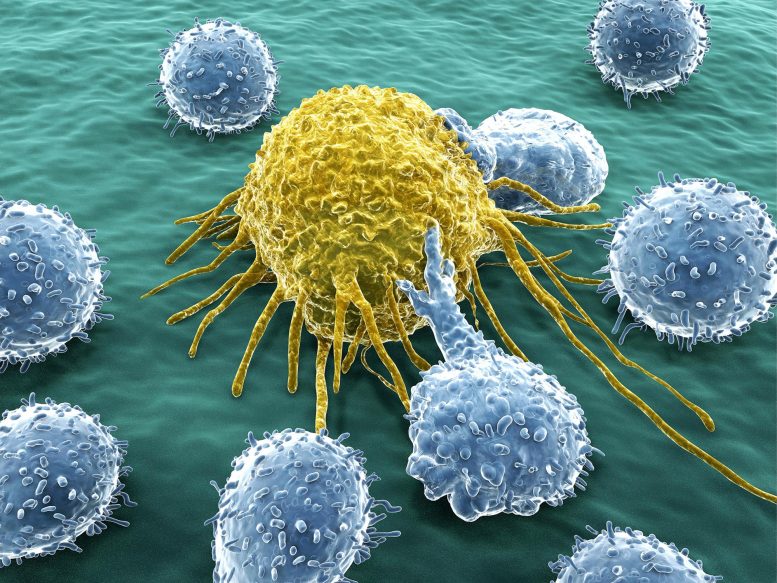
The new compound called ERX-41 kills a broad spectrum of hard-to-treat cancers.
A new molecule created by a researcher at the University of Texas at Dallas kills a variety of difficult-to-treat cancers, including triple-negative breast cancer, by taking advantage of a weakness in cells that was not previously targeted by existing drugs.
The research, which was conducted using isolated cells, human cancer tissue, and mouse-grown human cancers, was recently published in Nature Cancer.
A co-corresponding author of the study and an associate professor of chemistry and biochemistry in the School of Natural Sciences and Mathematics at the University of Texas at Dallas, Dr. Jung-Mo Ahn has dedicated more than ten years of his career to developing small molecules that target protein-protein interactions in cells. He previously created potential therapeutic candidate compounds for treatment-resistant prostate cancer and breast cancer using a method called structure-based rational drug design.
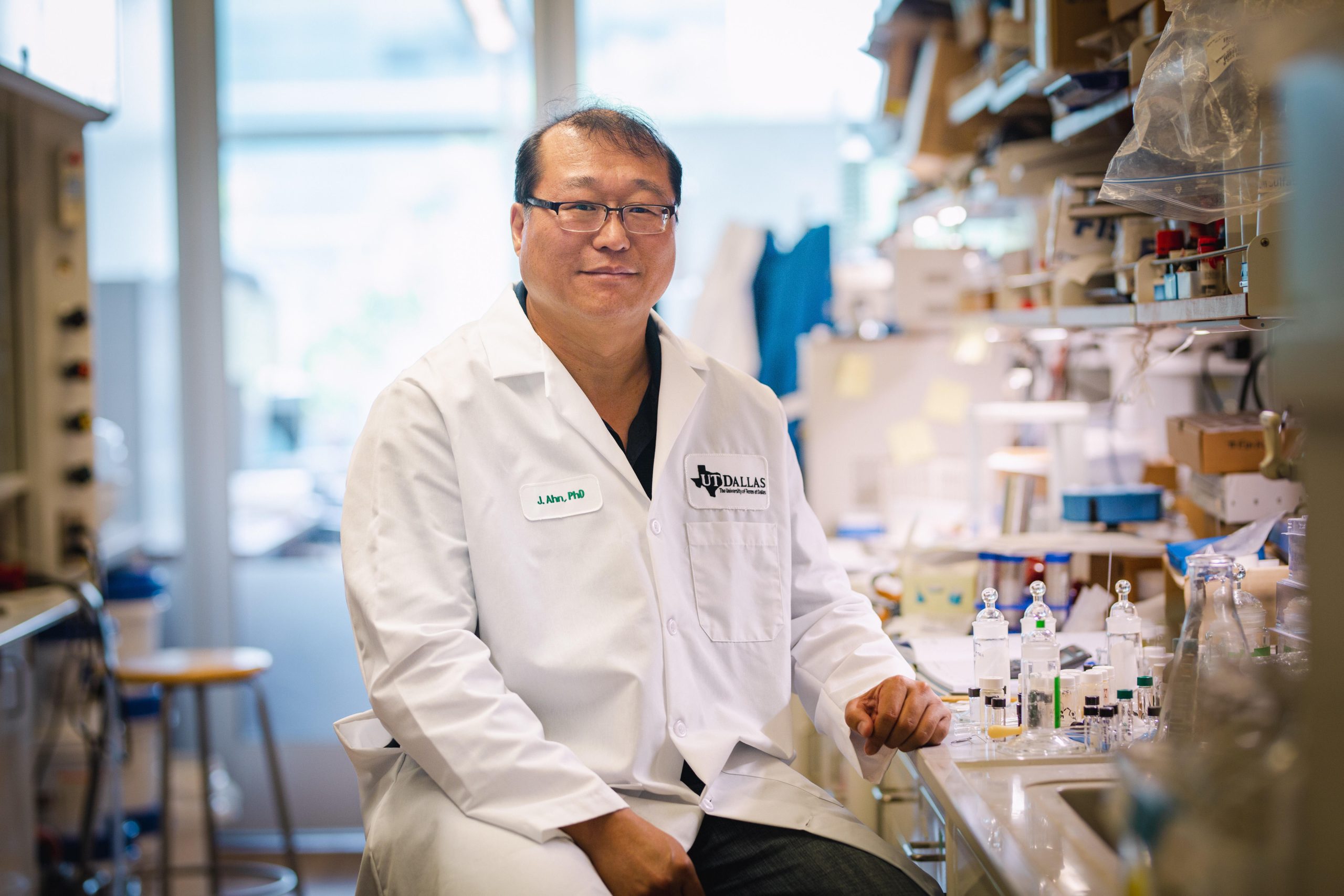
Dr. Jung-Mo Ahn, associate professor of chemistry and biochemistry at The University of Texas at Dallas, synthesized a novel compound called ERX-41 that kills a broad spectrum of hard-to-treat cancers, including triple-negative breast cancer, by exploiting a weakness in cells not previously targeted by other drugs. Credit: The University of Texas at Dallas
In the current work, Ahn and his colleagues tested a novel compound he synthesized called ERX-41 for its effects against breast cancer cells, both those that contain estrogen receptors (ERs) and those that do not. While there are effective treatments available for patients with ER-positive breast cancer, there are few treatment options for patients with triple-negative breast cancer (TNBC), which lacks receptors for estrogen, progesterone, and human epidermal growth factor 2. TNBC generally affects women under 40 and has poorer outcomes than other types of breast cancer.
“The ERX-41 compound did not kill healthy cells, but it wiped out tumor cells regardless of whether the cancer cells had estrogen receptors,” Ahn said. “In fact, it killed the triple-negative breast cancer cells better than it killed the ER-positive cells.
“This was puzzling to us at the time. We knew it must be targeting something other than estrogen receptors in the TNBC cells, but we didn’t know what that was.”
To investigate the ERX-41 molecule, Ahn worked with collaborators, including co-corresponding authors Dr. Ganesh Raj, professor of urology and pharmacology at the Harold C. Simmons Comprehensive Cancer Center at UT Southwestern Medical Center, as well as Dr. Ratna Vadlamudi, professor of obstetrics and gynecology at UT Health San Antonio. Dr. Tae-Kyung Lee, a former UTD research scientist in Ahn’s Bio-Organic/Medicinal Chemistry Lab, was involved in synthesizing the compound.
The researchers discovered that ERX-41 binds to a cellular protein called lysosomal acid lipase A (LIPA). LIPA is found in a cell structure called the endoplasmic reticulum, an organelle that processes and folds proteins.
“For a tumor cell to grow quickly, it has to produce a lot of proteins, and this creates stress on the endoplasmic reticulum,” Ahn said. “Cancer cells significantly overproduce LIPA, much more so than healthy cells. By binding to LIPA, ERX-41 jams the protein processing in the endoplasmic reticulum, which becomes bloated, leading to cell death.”
The research team also tested the compound in healthy mice and observed no adverse effects.
“It took us several years to chase down exactly which protein was being affected by ERX-41. That was the hard part. We chased many dead ends, but we did not give up,” Ahn said.
“Triple-negative breast cancer is particularly insidious — it targets women at younger ages; it’s aggressive, and it’s treatment-resistant. I’m really glad we’ve discovered something that has the potential to make a significant difference for these patients.”
The researchers fed the compound to mice with human forms of cancerous tumors, and the tumors got smaller. The molecule also proved effective at killing cancer cells in human tissue gathered from patients who had their tumors removed.
They also found that ERX-41 is effective against other cancer types with elevated endoplasmic reticulum stress, including hard-to-treat pancreatic and ovarian cancers and glioblastoma, the most aggressive and lethal primary brain cancer.
“As a chemist, I am somewhat isolated from patients, so this success is an opportunity for me to feel like what I do can be useful to society,” Ahn said.
Reference: “Targeting LIPA independent of its lipase activity is a therapeutic strategy in solid tumors via induction of endoplasmic reticulum stress” by Xihui Liu, Suryavathi Viswanadhapalli, Shourya Kumar, Tae-Kyung Lee, Andrew Moore, Shihong Ma, Liping Chen, Michael Hsieh, Mengxing Li, Gangadhara R. Sareddy, Karla Parra, Eliot B. Blatt, Tanner C. Reese, Yuting Zhao, Annabel Chang, Hui Yan, Zhenming Xu, Uday P. Pratap, Zexuan Liu, Carlos M. Roggero, Zhenqiu Tan, Susan T. Weintraub, Yan Peng, Rajeshwar R. Tekmal, Carlos L. Arteaga, Jennifer Lippincott-Schwartz, Ratna K. Vadlamudi, Jung-Mo Ahn, and Ganesh V. Raj, 2 June 2022, Nature Cancer. DOI: 10.1038/s43018-022-00389-8
Ahn is a joint holder of patents issued and pending on ERX-41 and related compounds, which have been licensed to the Dallas-based startup EtiraRX, a company co-founded in 2018 by Ahn, Raj, and Vadlamudi. The company recently announced that it plans to begin clinical trials of ERX-41 as early as the first quarter of 2023.
The study was funded by the National Cancer Institute, the Cancer Prevention and Research Institute of Texas, and The Welch Foundation.
On the one-year anniversary of the U.S. withdrawal from Afghanistan, the focus is rightfully on the chaotic and deadly evacuation of refugees, allies, and Westerners that swamped Kabul International Airport last summer.
But after reflecting on the Afghans left behind to live under the Taliban, the 10 civilians the U.S. killed on its way out, and the 13 Americans who died by an Islamic State suicide bomber at Abbey Gate, serious thought should be paid to how much the U.S. simply got wrong about the war from the very start.
A new book by Dutch journalist Bette Dam chronicles some of those missteps, such as President George W. Bush’s administration’s decision to reject a Taliban surrender in December 2001, and the dubious Afghan warlords the U.S. allied with over the two decades that followed.
Dam, who lived and worked in Afghanistan for 15 years, may draw ire for the unorthodox findings in her book, “Looking for the Enemy: Mullah Omar and the Unknown Taliban,” especially her reporting on the elusive life and final resting place of Mullah Muhammad Omar, the Taliban’s lodestar.
But if her work makes one thing clear about Afghanistan, it’s how little U.S. leaders, including top generals, diplomats, and politicians, understood about the situation there for 20 years.
U.S. leadership was consistently caught flat-footed, failing to deliver on their perennial promise to “turn the corner” in the war. The same leadership was again shocked by the Taliban’s breezy sweep across the country in summer 2021. Taking stock of the war will require humility at the top echelons of American power, and they could start by reading a book that challenges much of their orthodoxy.
Editor’s note: This interview has been edited for length and clarity
One of the biggest top lines from your work is the assertion that Taliban founder Mullah Omar lived out his final days close to a U.S. military base in his native Zabul Province in Afghanistan, and not, as the CIA and other experts have long argued, in Pakistan. How did you come to a conclusion so different from the mainstream here?
Early on, I couldn’t believe Mullah Omar was not in Pakistan. I describe in the book how already in 2012 people from Zabul, whom I knew from my first book, told me one evening when they were visiting friends in Kabul to go and look in Zabul, because it was Omar’s father’s land. I thought, ‘No, that’s not possible,’ and searched in Pakistan.
I made the same assumptions as the CIA, but after five years, my investigation forced me to say: Omar was indeed in Afghanistan. I went in May this year to the location of Omar’s house in Zabul, and indeed the U.S. Camp Wolverine is within walking distance.
The U.S. military even had one of these intel-gathering balloons hanging on top of the base, so they were able to see Mullah Omar sit in his garden. Except, they were not looking. They themselves had a strong bias towards Pakistan. That’s understandable. Most of the Taliban tried to live there. But understanding the underlying narratives of the Taliban would also have led the CIA to Mullah Omar.
What is an example of one of those underlying narratives?
The overall distrust of the Taliban leader, and his men, towards Pakistan, could have led to broader intel-gathering also in Afghanistan. While the U.S. government states that the relationship between Pakistan and the Taliban is very good, I didn’t see that in the field. I saw nervousness, distrust.
What should the media, intelligence community and military have done differently, on a day-to-day level?
We too often have secondary sources, we cling to the elite, who mostly speak English — that works the fastest — and most media stayed in Kabul. Traveling into the countryside didn’t happen enough, even though the resistance started in the villages. Surely, we reported criticism — too many civilian casualties, human rights abuses, torture, corruption in elections. We reported on emotion, like the pain of attacks or the pain of war. That’s important. But the more independent questions were not asked enough: ‘Was this a war? Was this terrorism? Is the military necessary here?’
Bette Dam, pictured here in Afghanistan, worked as a correspondent for NRC Handelsblad and Radio Netherlands Worldwide. (Courtesy photo)
One of the more jarring parts of your book is the scene in which Mullah Omar gives his blessing for a Taliban surrender in December 2001. I didn’t realize this offer occurred or that theU.S. rejected it. Do you think that deal could have succeeded?
It’s unforgivable that we have overlooked such a massive peace offer from the Taliban in 2001. It requires systemic self-reflection. Would it have succeeded? Many of the U.S. officials I spoke to say, ‘Oh, of course not. Kabul would not have been able to hold this peace deal together.’ I find that arrogant.
What we know is that the U.S. singlehandedly blocked the deal. Yes, it’s difficult to say anything in hindsight, but, to me, there is no doubt there would have been a longer moment of calmness.
The soon-to-be president of Afghanistan, Hamid Karzai, would have gone to Kabul, and would have had a solid base to start the new government. He was trying to be powerful and to be in contact with his natural enemies, Northern Afghans, who had already taken Kabul, but had agreed to share power (like many Taliban, Karzai is a Pashtun from Southern Afghanistan). To set up this very sensitive balance of shared power is not easy, and requires patience and time. Sharing power is difficult in any country, let alone in a country with the pain of 40 years of war.
One theme running through your book is how Afghanistan’s complicated tribal relations and business rivalries colored the conflict. How much do you think top Western leaders understood these dynamics?
I think we gave the space to these Afghan leaders to act like that because of our lack of knowledge. What we sometimes forget is that these Afghans have a history, as human beings have. One aspect is decennia-long rivalries, and especially in the first four years, 2001-2004, when there was not a strong Taliban, the U.S. goal ‘to kill Taliban,’ was misused by these leaders to solve rivalries and competition.
The U.S. should have cross-checked their allies much more. But the U.S. knew it all better. Figures like Asadullah Khalid were ‘the strong fighters’ and ideal ‘for killing terrorists’ and these Afghan leaders became supermen. (Khalid is a former Afghan defense minister who was accused of ordering the bombing of a U.N. convoy to protect his narcotics interests).
Mid-level State Department and Pentagon personnel knew something was wrong. But somehow knowledge was not always valued by the top. Ideology pushed it away, and instead, the binary idea of us-versus-Taliban prevailed.
If we had a more independent press, who would have systematically said that the Asadullah Khalid figures in Afghanistan, our allies, are killing rivals, that our U.S. soldiers die because of local rivalry fights and not Taliban, I think that it would have cracked the binary thinking. That would have taken away the urge for military use. The lack of this critical thinking among the American elites is extremely worrying to me, especially since we are now engaging in Ukraine with the same press, a country we also push in this binary, uninformative narrative.
What was an example you saw of the U.S. using force and it clearly not working?
Most leaders who were installed after Sept. 11, 2001, were given carte blanche to attack the enemy, while Taliban had surrendered. Tribal fights and competition between individuals were solved under the banner of terrorism. Police commander Abdul Raziq in Kandahar was proven by in-depth articles a spoiler and created more conflict than necessary. While those feature articles were strongly sourced, the U.S. government didn’t adapt.
It was truly painful for me to see how often the U.S. military let itself be misled in its selection of the enemy in Afghanistan. The intel-gathering was poor. The wrong people were killed, and their families ran immediately to the Taliban. This was systemic, from 2002-on. ... The U.S. picks an ally, and puts its arm around it and says, ‘We are in this together.’
Dutch journalist Bette Dam lived and worked in Afghanistan for 15 years. (Courtesy photo)
In late July, a U.S. drone strike killed al-Qaida leader Ayman al-Zawahiri in Kabul. Your book describes how the relationship between Osama Bin Laden and Taliban leaders was nuanced in the years before Sept. 11, 2001, and their ties weren’t strong. But some see the presence of Zawahiri in Taliban-controlled Kabul as both aviolation of the Doha agreementand an indication that the Taliban and al-Qaida remain close.
We do know from more independent research that there has been a consistent, as I call it, ‘gray area policy’ of the Taliban towards the Arabs present in the country, some of whom are in al-Qaida and some of whom are not. The Taliban’s rule is hospitality until justice proves you are guilty, but you need to lay low and not cause trouble, as Bin Laden did in the late 1990s when he was convicted by the Taliban for giving press conferences against their wishes.
At the moment, a lot is unclear about what happened with Zawahiri. I am not in Kabul at the moment, so I, unfortunately, can’t figure it out. We see that the intel fluctuates.
(Dam pointed to a U.S. intelligence community assessment from mid-August indicating that al-Qaida has not reconstituted in Afghanistan and Zawahiri was the only key al-Qaida figure who tried to reestablish himself in the country since U.S. forces withdrew.)
In the U.S., the overall analysis is that al-Zawahiri’s presence in Kabul is proof that Taliban are close allies of al-Qaida and a threat for international security. Is that so? You could also include the complexity I describe in the book. ... Learn from history and investigate if it was a way for the Taliban to keep al-Zawahiri silent.
International Crisis Group expert Jerome Drevon talked to sources within al-Qaida recently, who said that al-Qaida agreed with the Taliban to be silent, and not active.
In this 1998 file photo, Ayman al-Zawahri, left, listens during a news conference with Osama bin Laden in Khost, Afghanistan. (AP Photo/Mazhar Ali Khan, File)
A good portion of your book discusses the international isolation the Taliban faced in the 1990s, and you suggest that this was a mistake. Do you think the Biden administration is making the same mistake today by withholding billions of dollars in Afghanistan’s U.S.-held frozen assets?
I was with a Western journalist in Kabul recently: the journalist tried their best, but at the same time almost lectured the Taliban instead of interviewing. It was only Western narratives the journalist pasted on the country. That’s a small example of something bigger. The West finds listening to the other difficult. ... True, we do have so much to offer. We have peace, money, power to change for the good.
But the Taliban have realities, too, that are as true as ours. ... Taliban is fractured, Islamic, not as anti-western as Hamas or al-Qaida, arrogant, uneducated, extremely tribal, predominantly pro-girls’ education, willing to rebuild Afghanistan, but demanding autonomy.
Would you really say the Taliban are ‘predominantly’ pro-girls’ education? Currently, there is a ban in Afghanistan on girls attending secondary education. Although there isopposition to that ban— and even defiance from some Taliban — it’s still in force.
After my return from Kabul in May I would say the news headline on girls’ education could well be, ‘80% of the Taliban-leaders want girls’ education.’ Or, ‘Taliban-leaders openly revolt against their top leaders who are a minority in stopping girls’ education.’
There is a bigger part of the Taliban leadership who are more pro-girls’ education than anti-girls’ education. What should be investigated is the stubbornness of three or four Taliban leaders in Kandahar. Why are they against this? How big is their leverage? I don’t see calm reporting. I see emotion. Judgmental tweets of diplomats, where any knowledge or reflection lacks.
Final thoughts?
We, as Western media, embraced the War on Terror, and for that, the enemy of the U.S. government became the enemy of journalism. That is unethical if you look at it from a journalistic perspective. The War on Terror was a creation of the U.S. government and needed cross-check. Also, the media doesn’t have enemies; we have to try to talk to all sides. But because we embraced the War on Terror ideology, we only minimally interviewed the Taliban; mostly, we called their spokesman who had to deny or embrace an attack. That’s amplifying the propaganda channels. How many ‘jihad-watchers’ do not simply retweet Taliban and ISIS channels on Twitter? I find that irresponsible. PR from U.S., from the Taliban, from any organization, needs cross-checking if you take your audience serious. That did happen in feature articles or in some books. But these insights didn’t reach the mainstream narratives the big agencies — like Reuters, AP, etc. — were producing every day.
Kyle Rempfer is an editor and reporter whose investigations have covered combat operations, criminal cases, foreign military assistance and training accidents. Before entering journalism, Kyle served in U.S. Air Force Special Tactics and deployed in 2014 to Paktika Province, Afghanistan, and Baghdad, Iraq.
August 27, 2022 at 03:06AM
https://www.militarytimes.com/flashpoints/afghanistan/2022/08/26/new-book-on-mullah-omar-and-the-taliban-offers-hard-lessons-for-the-us/
New book on Mullah Omar and the Taliban offers hard lessons for the US - Military Times


:quality(70)/cloudfront-us-east-1.images.arcpublishing.com/archetype/KZ7N6N72AFBS7OXU2DLRSFLD7Q.JPG)
